

 Adventure Tours
Most travel planning begins with a forecast. Sunshine is preferred, rain is avoided, wind is negotiated, and snow is often treated as disruption. Yet weather is not an obstacle to travel—it is one of its most honest companions. Weather Accepted Travel is a philosophy that releases control and allows journeys to move in partnership with natural conditions rather than against them.
This approach does not chase perfect skies. Instead, it welcomes clouds, fog, rain, cold, heat, and shifting atmospheres as integral parts of the experience. Travel becomes less about managing nature and more about listening to it.
Letting Go of the Ideal Conditions Mindset
The idea that a place must be experienced under “ideal” weather conditions is largely a modern construct. Historically, people traveled regardless of conditions, adapting their movement, shelter, and expectations to what the land and sky offered.
Weather Accepted Travel returns to this mindset. It removes the pressure to optimize every moment and replaces it with responsiveness. Instead of asking, Is the weather good enough? the traveler asks, What does this weather invite me to experience today?
This shift opens unexpected dimensions of place—ones that fair-weather travel often misses.
Weather as a Co-Creator of Experience
Weather shapes sound, visibility, mood, and rhythm. Rain softens landscapes. Fog simplifies horizons. Wind sharpens awareness. Snow quiets movement. Heat slows time.
When weather is accepted rather than resisted, it becomes a collaborator. Routes change. Activities adapt. Stillness often replaces speed. The result is not loss, but depth.
A coastline in heavy mist feels entirely different from the same shore under bright sun—neither is better, only different.
Places Where Weather Acceptance Transforms Travel
Some regions naturally lend themselves to this philosophy, not because of predictability, but because of their expressive climates.
1. Lofoten Islands, Norway
In Lofoten, weather shifts rapidly—clear skies can turn to wind and snow within hours. Rather than resisting this, Weather Accepted Travel encourages adapting movement to conditions.
Stormy seas become moments for shelter and observation. Clear breaks invite sudden exploration. The dramatic interplay between sky, ocean, and mountains becomes the journey itself.
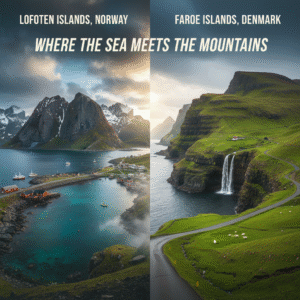
2. Faroe Islands, Denmark
Fog, rain, and wind dominate much of the Faroe Islands’ climate. Instead of limiting travel, these conditions enhance it.
Cliffs disappear into clouds. Waterfalls grow stronger in rain. Visibility shifts constantly, turning familiar paths into new experiences each day. Weather Accepted Travel allows the islands to be experienced as living systems rather than fixed scenery.
3. Iceland’s South Coast

Iceland’s weather is famously unpredictable. Accepting it reveals the land’s full character.
Rain intensifies waterfalls like Skógafoss. Overcast skies deepen volcanic textures. Sudden sunlight feels earned rather than expected. Travelers who stop chasing forecasts often discover a more intimate connection to Iceland’s elemental nature.
Movement Adjusted by Conditions
Weather Accepted Travel changes how movement is planned. Instead of rigid daily itineraries, days are shaped by what conditions allow.
Windy days become slow walks or stationary observation. Rain invites indoor cultural spaces or quiet reflection. Clear windows encourage spontaneous exploration. This flexibility reduces stress and increases attunement to surroundings.
Travel becomes responsive rather than directive.
Clothing, Shelter, and Mindset
This approach does not ignore preparation. Instead, it prioritizes readiness over resistance. Proper layering, waterproof gear, and adaptable shelter support comfort without demanding control over conditions.
More importantly, mindset becomes the primary tool. When travelers stop viewing weather as a problem, discomfort decreases. Acceptance replaces frustration, and adaptability becomes a form of skill.
Emotional Shifts in Weather-Led Travel
Weather Accepted Travel often produces emotional shifts that fair-weather travel does not. Rain encourages introspection. Fog invites inward focus. Cold sharpens awareness. Heat softens urgency.
These emotional responses are not distractions—they are part of the journey. Weather becomes a mirror, reflecting internal states and encouraging slower, more reflective engagement.
Many travelers report feeling more grounded and emotionally present when weather is allowed to lead.
Reducing Control, Increasing Presence
Modern travel often revolves around control—booking, scheduling, predicting. Weather Accepted Travel intentionally loosens this grip.
When plans remain flexible, disappointment fades. Curiosity grows. Each day feels less like execution and more like conversation with place.
This approach restores a sense of trust in the journey itself.
Why This Style of Travel Is Growing
As travelers seek meaning over volume, Weather Accepted Travel is gaining quiet momentum. It aligns with slow travel, sustainability, and nervous-system-friendly exploration.
It reduces pressure. It supports deeper connection. And it reflects a growing desire to experience places as they are, not as they are marketed.
In a world increasingly shaped by control and optimization, weather-led journeys feel refreshingly honest.
Traveling With Nature, Not Against It
Weather Accepted Travel is not passive—it is attentive. It does not surrender agency, but redistributes it between traveler and environment.
By flowing with nature rather than fighting it, journeys become calmer, richer, and more resilient. Places reveal themselves in layers rather than highlights. Experience replaces expectation.
In the end, weather is not something that happens to travel.
It is something that shapes it.
When accepted, it transforms movement into relationship—and travel into a dialogue with the living world.

