

 Adventure Tours
We have learned to travel with a camera always ready.
Phones charged. Storage cleared. Angles considered.
Before the moment fully lands, we are already thinking about how to capture it.
But not every experience asks to be documented.
Some ask to be lived.
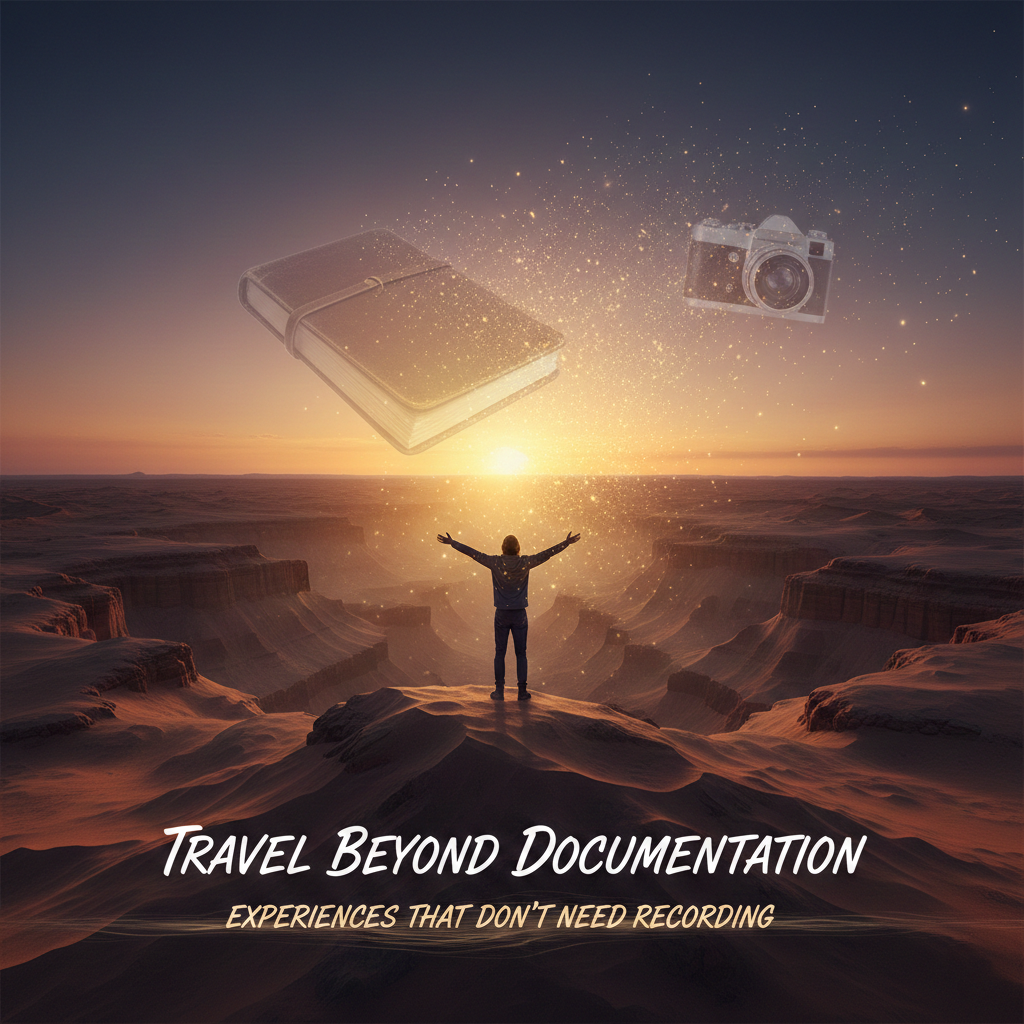
Travel beyond documentation is not anti-technology. It is anti-distraction. It is the conscious choice to step out of constant recording and into direct presence — to let moments exist without proof.
Because some experiences deepen when they remain unshared.
The Habit of Recording Everything
Modern travel culture often revolves around visibility.
Landmarks are photographed before they are felt. Meals are styled before they are tasted. Sunsets are recorded before they are watched.
The question shifts from:
“How does this feel?”
to
“How will this look?”
Documentation becomes automatic. The lens stands between you and the moment.
And slowly, subtly, experience becomes performance.
The Cost of Constant Capture
Recording every moment fragments attention.
When you divide awareness between living and capturing, presence weakens. Your mind evaluates framing, lighting, and reaction instead of absorbing sound, temperature, texture, and emotion.
The nervous system never fully settles.
Moments pass, archived but not integrated.
Paradoxically, documenting everything can reduce memory depth. Research suggests that when we rely on external recording devices, our brains engage less deeply in encoding the experience.
When you don’t record, you remember differently — more vividly, more personally.
Memory as a Living Archive
Before digital storage, memory was the primary archive.
Stories were told, not posted.
Details were recalled imperfectly — and that imperfection gave them warmth.
When you travel without documenting everything, you allow memory to do its work. The mind selects what mattered. It preserves the feeling rather than the angle.
A breeze across your skin.
The quiet hum of a train carriage.
The rhythm of footsteps on unfamiliar pavement.
These are not easily captured on screen.
But they remain.
The Freedom of Not Proving
When you stop documenting, you stop proving.
You do not need evidence that you were there. You do not need validation in the form of likes or comments.
The experience belongs entirely to you.
This shifts travel from exhibition to intimacy.
You notice more when no audience exists.
You move more slowly when you are not staging.
You engage more fully when nothing must be shared.
Freedom appears in the absence of performance.
Presence Over Perfection
Documenting often encourages perfection.
The perfect shot.
The perfect timing.
The perfect aesthetic.
But presence is imperfect.
Clouds interrupt sunsets.
Street noise disrupts silence.
Unexpected rain changes plans.
When you are not trying to capture perfection, you become receptive to reality.
Travel beyond documentation embraces what unfolds rather than curating what looks ideal.
Deepening Sensory Awareness
When your phone stays in your pocket, your senses expand.
You hear conversations around you more clearly.
You notice architectural details.
You feel temperature shifts.
You observe expressions.
Your awareness widens.
Without the mediation of a screen, colours appear richer. Time feels slower. The environment becomes immersive rather than framed.
This immersion is the essence of meaningful travel.
Private Moments Hold Unique Power
Not all beauty needs an audience.
Some of the most transformative travel experiences are quiet:
-
Sitting alone at dawn before a city wakes
-
Sharing unfiltered laughter with a stranger
-
Standing silently before a vast landscape
-
Watching light move across unfamiliar walls
These moments gain power because they are undisturbed.
Recording can introduce distance. Privacy invites depth.
Redefining What Travel Is For
If travel is for content, documentation is central.
If travel is for connection, presence is central.
Beyond documentation, travel becomes:
-
Restorative
-
Reflective
-
Grounding
-
Personal
It becomes less about visibility and more about integration.
The question shifts from “What did I capture?” to “What changed in me?”
Practical Ways to Travel Beyond Documentation
This does not require abandoning photography entirely.
It requires intention.
Consider:
-
Designating specific times for photos, then putting the device away
-
Choosing one meaningful image instead of dozens
-
Leaving certain experiences entirely undocumented
-
Journaling feelings instead of posting highlights
-
Turning off notifications while exploring
The goal is balance — capturing without replacing.
Letting Experiences Breathe
When moments are not immediately shared, they have space to settle.
You reflect more deeply.
You speak about them differently.
You integrate them into your internal narrative rather than external identity.
Unshared experiences often feel more personal and enduring.
They become part of who you are, not just part of your feed.
Slowing Time
Documentation can accelerate perception. You rush from one photo opportunity to the next.
Without that pressure, time softens.
You linger longer at a café.
You walk without destination.
You sit without agenda.
Time feels fuller when it is not divided.
This is travel that expands rather than compresses experience.
The Paradox of Unrecorded Beauty
There is a quiet paradox:
Moments that are not recorded often become the ones you treasure most.
Because they were uninterrupted.
Because they were complete.
Because they were yours.
No filter improved them. No caption interpreted them. No audience shaped them.
They remain intact in memory — raw and real.
Connection Without a Screen
Travel is ultimately about connection:
To place.
To culture.
To people.
To self.
Screens can connect us digitally, but they can also interrupt immediate connection.
When documentation steps back, conversations deepen. Eye contact strengthens. Shared silence feels comfortable.
You are not half-present.
You are there.
Fully.
A Shift in Identity
When you stop documenting constantly, something subtle shifts in identity.
You become a participant rather than an observer of your own life.
You trust that meaningful experiences do not require external confirmation.
You allow your journey to exist without proof.
That trust builds internal confidence.
The Quiet Confidence of Unshared Moments
There is a particular calm in knowing that something beautiful happened — and only you know the full depth of it.
Not because it was secret.
But because it was sacred in its simplicity.
Travel beyond documentation cultivates this quiet confidence.
It values depth over display.
Final Thoughts
Experiences do not need recording to be real.
They do not require evidence to matter.
Travel beyond documentation invites you to loosen your grip on constant capture and strengthen your connection to presence.
Take the photo — when it feels meaningful.
But also put the camera down.
Let the wind move across your skin without framing it.
Let the sound of distant streets settle without filtering it.
Let the moment belong to you — completely.
Because some experiences are most powerful when they remain unrecorded.

