

 Adventure Tours
Not all shared travel feels shared in a healthy way. Too often, traveling with others carries unspoken expectations—matching energy levels, agreeing on plans, filling silence, staying entertained. The pressure to synchronize perfectly can quietly drain what was meant to restore.
But there is another way to travel together.
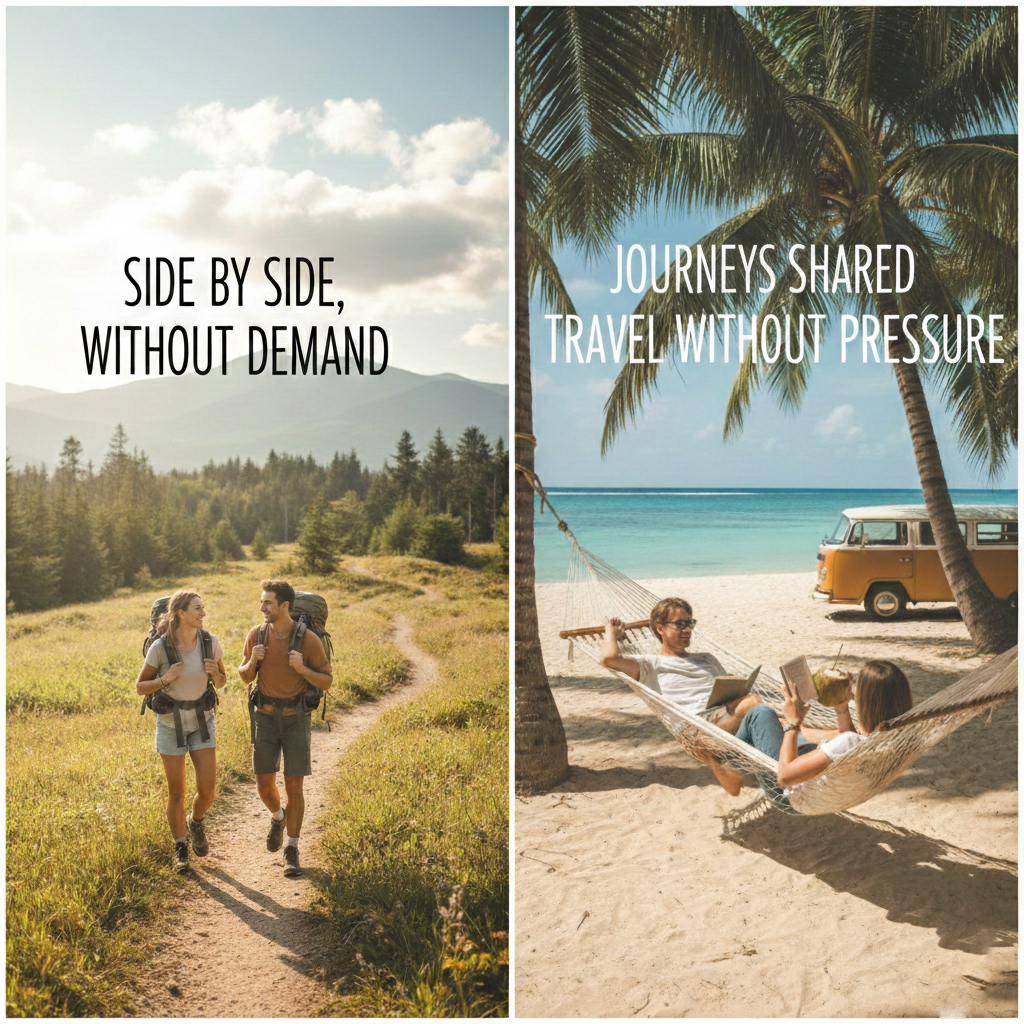
Side By Side Without Demand is a philosophy of shared journeys built on spaciousness. It is about moving in proximity without obligation. It allows connection without control, companionship without performance, and presence without pressure.
These journeys don’t require constant agreement. They don’t demand enthusiasm at every turn. They simply invite people to walk beside one another—comfortably, quietly, and freely.
What Shared Travel Without Pressure Looks Like
Travel without pressure is not passive or disengaged. It is attentive and respectful. It recognizes that two people can experience the same place differently and still remain connected.
In this model:
-
Silence is welcome
-
Diverging interests are allowed
-
Rest is not questioned
-
Plans are flexible
-
Emotional space is respected
You don’t need to entertain your travel companion. You don’t need to optimize every moment together. You simply move alongside each other.
Why Pressure Creeps Into Travel
Shared travel often amplifies expectations. People want the trip to feel meaningful, productive, or memorable. That desire can unintentionally create tension.
There is pressure to:
-
See everything
-
Stay aligned on preferences
-
Avoid conflict
-
Make the trip “worth it”
Side By Side Without Demand releases those invisible contracts. It replaces them with mutual trust.
Walking Together, Not Managing Each Other
One of the simplest images of pressure-free travel is walking side by side. No one leads aggressively. No one trails resentfully. Steps adjust naturally.
In places like Kyoto, Japan, quiet temple paths encourage this kind of shared movement. Visitors drift through moss gardens or narrow stone streets without the need for constant conversation. The setting itself softens urgency.
Similarly, along the canals of Amsterdam, Netherlands, companions can walk in silence, pausing when something draws attention. The city’s rhythm allows shared wandering without choreography.
When environments are human-scaled, shared travel feels lighter.
Allowing Separate Experiences Within the Same Journey
Travel without demand does not require identical experiences. In Lisbon, Portugal, one traveler may linger at a viewpoint while another explores a nearby street. They reconvene naturally, enriched rather than divided.
On Vancouver Island, Canada, one person might choose a forest walk while the other rests by the water. The shared base remains constant, but movement within it is fluid.
This autonomy strengthens companionship rather than weakening it. When individuals feel free, connection becomes voluntary instead of obligatory.
Silence as Shared Comfort
Silence is often misunderstood as disconnection. In pressure-free travel, silence is a sign of ease.
In the wide landscapes of Iceland’s Westfjords, long stretches of road unfold without commentary. The land fills the space. Shared observation replaces small talk.
In the hill towns of Umbria, Italy, afternoon quiet naturally slows conversation. Sitting together in stillness feels sufficient.
Silence removes the need to perform engagement. It creates deeper companionship.
Reducing Decision Fatigue Together
Many travel tensions arise from constant decision-making. Where to eat. What to see. When to move.
Side By Side Without Demand simplifies choices:
-
Choose fewer destinations
-
Stay longer in each place
-
Keep daily plans minimal
-
Leave room for spontaneity
In compact cities like Ljubljana, Slovenia, options are close and manageable. Decision-making becomes lighter. Shared movement feels organic.
Reducing logistical strain lowers interpersonal strain.
Respecting Energy Differences
No two people travel with identical stamina or curiosity. Pressure-free journeys respect that difference.
In Copenhagen, Denmark, bike rides can be as short or long as desired. One companion might extend a route while the other stops at a café. There is no sense of abandonment—only variation.

In the Lake District of England, gentle walking paths allow for natural pauses. Shared views matter more than covering distance.
When energy levels are honored, resentment disappears.
The Emotional Safety of Non-Demanding Travel
Travel without pressure creates emotional safety. Companions feel:
-
Less judged
-
Less rushed
-
Less obligated to entertain
-
More comfortable expressing needs
This safety allows genuine conversation to emerge naturally rather than forced interaction.
Often, the most meaningful exchanges happen when no one is trying to create them.
Shared Presence Over Shared Productivity
Modern travel culture emphasizes productivity—checking off landmarks, maximizing time. Shared productivity can become competitive or exhausting.
Side By Side Without Demand values shared presence instead. Sitting on the edge of Lake Bled in Slovenia, watching light shift across water, can be enough.
Walking through Granada, Spain, without racing between sites allows shared observation to replace schedule anxiety.
The journey becomes about being together, not accomplishing together.
Why This Style of Travel Strengthens Relationships
When pressure is removed, relationships settle. There is less friction, fewer compromises made in frustration, and more organic alignment.
Travel becomes:
-
A mirror of everyday compatibility
-
A practice of mutual respect
-
A space to observe without control
Side-by-side movement builds trust quietly.
Travel as Parallel Experience
Perhaps the most powerful aspect of pressure-free shared travel is the understanding that people can move in parallel without merging completely.
You can look at different details in the same landscape.
You can feel differently about the same sunset.
You can walk at slightly different speeds and still remain together.
Togetherness does not require uniformity.
Final Reflection
Side By Side Without Demand journeys redefine what it means to share travel. They replace expectation with ease, coordination with cooperation, and pressure with patience.
In these journeys, companionship is not measured by constant interaction but by comfortable proximity.
You don’t need to prove connection.
You simply walk beside it.
And sometimes, that quiet alignment—moving without demand—is the most generous form of travel there is.

