

 Adventure Tours
Most travel advice focuses on destinations, logistics, or productivity—how to see more, do more, and optimize time. Rarely do we examine how we carry ourselves while traveling. Yet the internal posture we bring to a journey shapes the experience as much as the landscape itself.
Non-defensive travel is a quiet but powerful shift. It replaces vigilance with openness, control with trust, and reaction with ease. When travelers move without bracing against uncertainty, the journey softens—and so does the self.
What Is Non-Defensive Travel?
Non-defensive travel refers to moving through unfamiliar places without constant self-protection. It is not naïveté or risk-taking, but a regulated state where the nervous system feels safe enough to remain open.
It involves:
-
Letting go of excessive control
-
Reducing anticipatory stress
-
Meeting situations without immediate judgment
-
Allowing experiences to unfold
The traveler becomes responsive rather than reactive.
Why We Travel Defensively Without Realizing It
Many travelers unconsciously carry defensive behaviors:
-
Overplanning to prevent discomfort
-
Tight schedules to avoid uncertainty
-
Emotional detachment from people and places
-
Constant comparison to expectations
These behaviors often stem from daily life, where hyper-vigilance is rewarded. Travel simply amplifies them.
Defensive travel keeps the nervous system alert, limiting depth, spontaneity, and connection.
Ease as a Nervous-System State
Ease is not a mindset—it is a physiological condition. When the nervous system feels safe, curiosity replaces fear, and presence replaces control.
Non-defensive travel supports this by:
-
Creating internal permission to slow down
-
Reducing sensory overload
-
Allowing mistakes without self-criticism
-
Accepting uncertainty as part of the journey
Ease becomes a companion, not a goal.
How Non-Defensive Travel Changes Perception
When defense drops, perception expands. Travelers notice subtle details that were previously filtered out by urgency or anxiety.
This includes:
-
Body language in local interactions
-
Shifts in light, sound, and texture
-
Emotional responses to place
-
Unspoken cultural rhythms
The journey becomes richer without becoming louder.
Movement Without Bracing
Defensive travel often shows up physically—tight shoulders, rushed walking, shallow breathing. Non-defensive movement is slower, softer, and more grounded.
It looks like:
-
Walking without urgency
-
Pausing without explanation
-
Choosing rest before exhaustion
-
Letting curiosity guide direction
The body leads, and the mind follows.
Encounters Without Armor
Travel is often framed as social exposure—meeting strangers, navigating cultural differences. Defensive travel approaches these moments cautiously, often keeping emotional distance.
Non-defensive travel allows:
-
Gentle conversation without performance
-
Listening without agenda
-
Mutual respect without overthinking
-
Boundaries without rigidity
Connection becomes natural rather than effortful.
Places That Encourage Non-Defensive Travel
Certain environments naturally support ease due to scale, pace, and cultural norms.
1. Luang Prabang, Laos

Slow daily rhythms, quiet streets, and gentle social interactions create an atmosphere of calm receptivity.
2. Faroe Islands

Sparse populations and vast open spaces reduce social pressure and mental noise.
3. Naoshima, Japan

Minimalist environments and contemplative spaces invite inward ease and unforced presence.
4. Isle of Skye, Scotland

Expansive nature and unpredictable weather teach acceptance over control.
Releasing the Need to Optimize
Non-defensive travel abandons optimization. There is no pressure to see everything or validate the journey through achievement.
Instead, it values:
-
Depth over breadth
-
Quality over quantity
-
Internal response over external proof
This release creates spaciousness in both schedule and mind.
Mistakes as Part of the Experience
Missed trains, wrong turns, language gaps—defensive travel treats these as failures. Non-defensive travel sees them as texture.
When mistakes are allowed:
-
Stress decreases
-
Adaptability increases
-
Stories become richer
-
Self-trust strengthens
The journey feels alive rather than fragile.
Ease as a Skill You Carry Home
The most lasting transformation of non-defensive travel is not what happens abroad—it’s what returns with you.
Travelers often notice:
-
Reduced reactivity
-
Increased patience
-
Greater tolerance for ambiguity
-
A softer internal dialogue
Ease becomes portable.
Practicing Non-Defensive Travel Intentionally
This way of traveling doesn’t require a specific destination. It requires awareness.
Simple practices include:
-
Leaving unplanned time daily
-
Checking in with the body before decisions
-
Choosing fewer destinations
-
Limiting constant documentation
-
Letting silence exist
Ease grows through permission.
Travel as Repatterning
Non-defensive travel subtly rewires how we respond to the unfamiliar. It teaches the nervous system that uncertainty does not equal danger.
Over time, this reconditioning affects:
-
How we handle change
-
How we relate to others
-
How we move through daily life
The journey reshapes more than memory—it reshapes response.
Final Thoughts
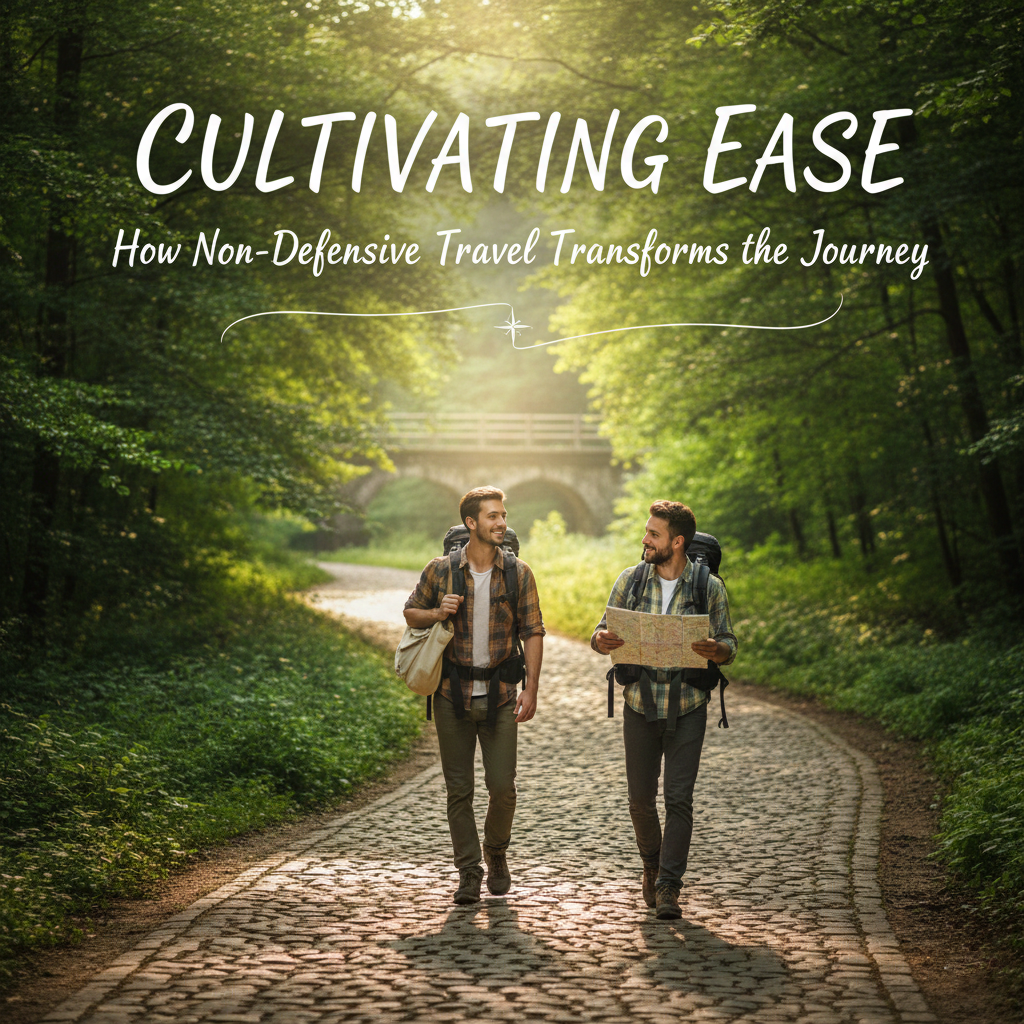
Cultivating Ease: How Non-Defensive Travel Transforms the Journey is an invitation to travel differently—not harder, not faster, but softer.
When we stop bracing against the unknown, travel stops being something we manage and becomes something we inhabit. Ease replaces vigilance. Curiosity replaces control.
And the journey, finally, meets us where we are—open, grounded, and unguarded.


